
For over a decade, SEO professionals and power users relied on the Google Search parameter &num=100 to display 100 search results on a single page. This feature made keyword research, competitor analysis, and rank tracking far more efficient.
But between September 12–14, 2025, Google officially stopped honoring the parameter. The change caught many SEO experts and tools off guard, as Search Console data, impressions, and keyword rankings began shifting overnight.
So, why did Google remove &num=100? What does it mean for SEO and digital marketers? And how can you adapt? Let’s break it down.
What Was &num=100 in Google Search?
Normally, Google displays 10 search results per page by default. Adding &num=100 to the search URL forced Google to show up to 100 results at once.
Example:
https://www.google.com/search?q=seo+tools&num=100
This was particularly valuable for:
- SEOs – Quickly scanning top 100 results for keyword competition.
- Marketers – Evaluating visibility across multiple competitors.
- Researchers – Gathering large datasets for analysis.
- Rank trackers – Checking keyword rankings beyond the top 10.
When Did Google Remove &num=100?
In September 2025, SEO professionals noticed that &num=100 was no longer working consistently.
- Sometimes it defaulted back to 10 results per page.
- Other times, the parameter was completely ignored.
- Google later confirmed that the parameter was no longer supported.
This sudden change directly impacted SEO tools and Search Console reporting, leading to widespread confusion in the SEO community.
Why Did Google Remove &num=100?
Google has not released a detailed explanation, but industry experts highlight several likely reasons:
- Reduce Server Load – Delivering 100 results at once consumes more resources than showing 10 or using infinite scroll.
- Curb Scraping and Automation – Many bots and SEO tools relied on
&num=100to mass scrape SERPs. - AI Scraping and Infrastructure Protection – The rise of AI-powered tools has led to aggressive scraping of Google’s results. Removing &num=100 helps protect Google’s infrastructure from heavy automated requests and reduces the risk of large-scale data harvesting.
- Align with Infinite Scroll UX – Google is pushing continuous scroll on desktop and mobile instead of large page sets.
- Improve Accuracy in Search Console – Impressions inflated by bots/tools could distort metrics. Removing
&num=100makes reporting cleaner. - Ad Visibility and Engagement – Fewer results per page increases chances users will see ads or refine queries.
Example of Bot Impressions Distorting Data
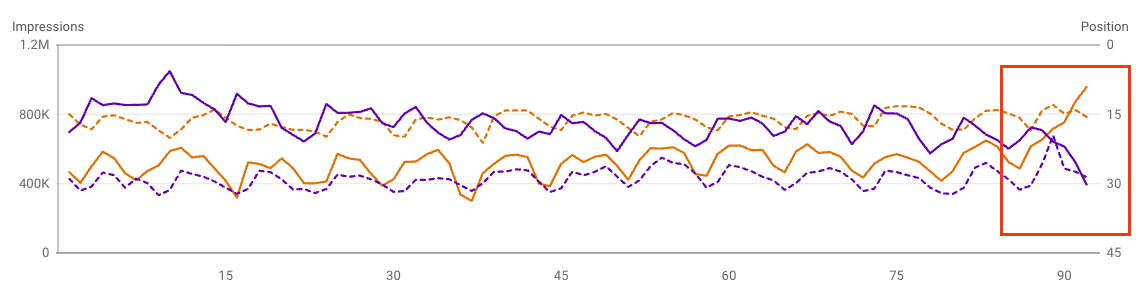
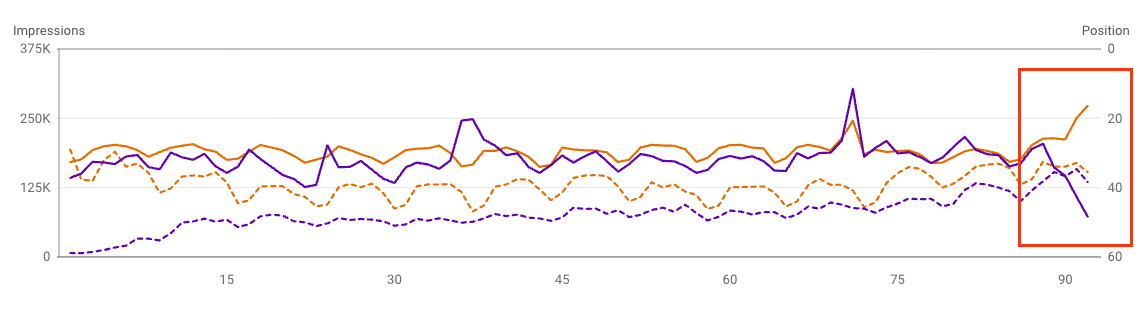
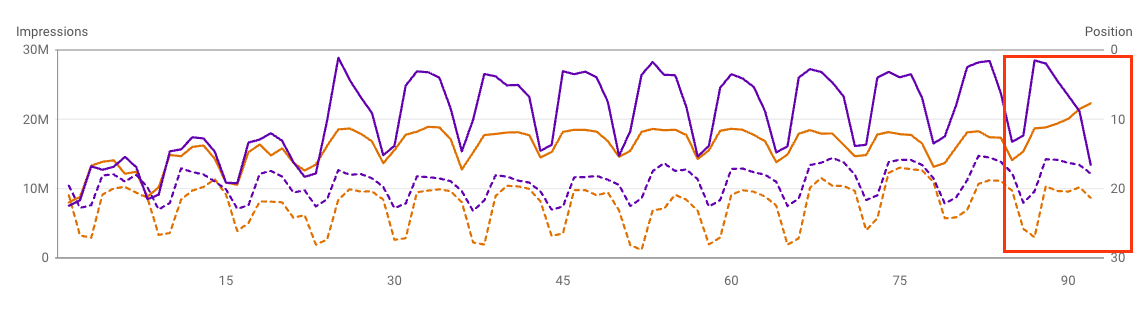
With &num=100 active, a site ranking at position #85 would still register an impression in Google Search Console, even if no real user scrolled that far.
For instance:
- 100 real impressions at position #8
- 500 bot/tool impressions at position #67
Google would calculate an average position around 57, instead of reflecting the stronger real-world visibility at #8.
By disabling &num=100, these artificial impressions disappear, so average position now looks more accurate and CTR stabilizes.
Ahrefs Confirms Impact of Google’s &num=100 Parameter Removal
Ahrefs Confirms Impact of Google’s &num=100 Parameter Removal
Ahrefs, one of the largest SEO platforms in the world, also confirmed the operational impact of Google’s decision to drop &num=100.
Since Ahrefs collects vast amounts of search data to power its keyword research and rank tracking features, the removal of this parameter means:
- More Requests Required – What used to take one request (100 results) now requires multiple paginated requests.
- Higher Operational Costs – Infrastructure and API costs rise due to additional crawling and data fetching.
- Adjustment of Metrics – Some rank tracking data and keyword difficulty scores may be recalibrated to reflect the new limitations.
Ahrefs’ acknowledgment, along with Semrush’s earlier confirmation, underscores just how significant this change is across the SEO industry.
Impact on SEO Professionals
The removal of &num=100 has several consequences for SEO:
- Keyword Research Disruption – Analyzing 100 results in one view is no longer possible.
- Rank Tracking Issues – Tools that tracked up to 100 results per query must now adapt.
- Search Console Data Drops – Many websites saw sudden impression decreases in September 2025 due to this change.
- Shifts in Average Position & CTR – With bot-driven impressions removed, many sites may notice their average position improving and click-through rates becoming more accurate, since reporting now reflects actual user visibility rather than inflated bot data.
- Operational Costs for SEO Tools – Platforms like Semrush and Ahrefs now need multiple requests to gather the same data, increasing costs.
👉 It’s important to note that this change doesn’t mean your rankings or visibility actually dropped — only the way Google reports impressions and positions has changed.
Why This Matters for Your Data
If you noticed sudden drops in impressions or shifts in average position around September 2025, your site didn’t actually lose visibility. What changed is how Google counts impressions. With &num=100 gone, many low-value impressions from deeper pages are no longer recorded, making data look “smaller” but more realistic. CTR may even appear steadier now, since impressions better reflect true user exposure.
Example of SERPs with &num=100 Active

Example of SERPs with &num=100 Disabled

Workarounds and Alternatives
If your SEO workflow relied on &num=100, here are some alternatives:
- Use Professional SEO Tools – Platforms like Ahrefs, SEMrush, and Serpstat provide top 100 results per keyword without relying on Google’s parameter.
- Paginate SERPs – Instead of fetching 100 results, pull multiple pages of 10 results each.
- Google Custom Search API – Developers can still access structured data, though limits apply.
- Embrace Continuous Scroll – While less efficient, scrolling still gives access to extended results.
- Monitor Search Console Carefully – Be aware that impressions may now reflect only visible user-facing results.
- Focus on Actionable KPIs – Instead of relying heavily on impressions, prioritize metrics that reflect real user behavior such as clicks, organic traffic quality, engaged sessions, and conversions. These give a truer picture of performance than impression counts.
Key Takeaways
- Google removed the
&num=100search parameter in September 2025. - The change impacts SEO tools, Search Console impressions, and keyword tracking.
- Both Semrush and Ahrefs confirmed major operational impacts from this removal.
- SEOs and marketers must adapt by using professional tools, APIs, or manual pagination.
- This move aligns with Google’s broader shift toward infinite scroll and AI-driven search experiences.
Conclusion
The end of &num=100 marks a major shift in how SEO experts analyze search results While it may improve Google’s efficiency and data accuracy, it adds friction for digital marketers who depended on bulk SERP analysis.
Going forward, the best approach is to rely on SEO platforms, adapt workflows, and accept that Google’s search experience is evolving away from old-school methods.
Looking Forward
This update may not be the last. As Google continues pushing AI-driven search and continuous scroll, further changes in how results are displayed and measured are likely. SEO professionals should stay flexible, monitor updates closely, and be ready to adapt workflows as Google reshapes the search experience.
FAQs
1. When did Google remove the &num=100 parameter?
Google removed support for the &num=100 parameter in September 2025. Before this change, users could view 100 search results on a single page by adding the parameter to the search URL.
2. Why did Google remove the &num=100 search parameter?
Google has not given an official detailed reason, but industry experts believe it was removed to reduce server load, prevent scraping by SEO tools, align with infinite scroll, and improve the accuracy of Search Console data.
3. How does the removal of &num=100 affect SEO experts?
The removal impacts SEO experts by making keyword research, rank tracking, and competitor analysis less efficient. Many SEO tools that relied on the parameter now face higher operational costs and must adjust their methods.
4. Did Ahrefs and Semrush confirm the impact of this change?
Yes, both Ahrefs and Semrush confirmed that Google’s removal of &num=100 caused major operational impacts, as their systems relied on this parameter to fetch up to 100 results per query efficiently.
5. Why did Search Console impressions drop in September 2025?
Many sites reported sudden impression drops in Google Search Console during mid-September 2025. This was due to the removal of &num=100, not a penalty. Fewer results are now being logged as impressions because 100-result pages are no longer generated.
6. What are the alternatives now that &num=100 is gone?
SEO experts can use tools like Ahrefs, Semrush, and Serpstat, rely on Google’s Custom Search API, or fetch multiple pages of results through pagination. Google’s continuous scroll also allows access to extended results, though less efficiently.
7. Does this change affect paid ads in Google Search?
No, the removal of &num=100 affects only organic search results. Paid ads are displayed based on Google Ads settings and are not impacted by this parameter.
8. Is this change permanent, or could Google make more updates?
While Google has not officially said if the removal of &num=100 is permanent, it aligns with their broader push toward AI Search and continuous scroll. It’s likely that more changes will come, so SEOs should expect ongoing adjustments in how data is reported and how users interact with search results.
Some images used in this article are sourced from Locomotive Agency.
Add a Comment